


Color codes HEX & RGB codes for these stones →
Choose options View details
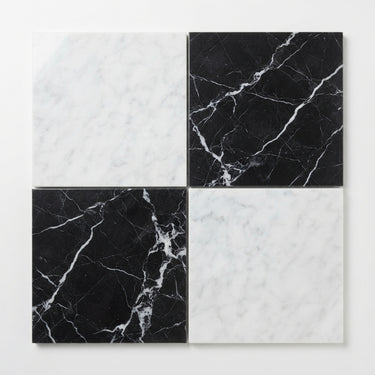
![Checkerboard Marble Tile - Thassos White & Nero Marquina]()
Choose options View details
![Checkerboard Marble Tile - Rosso Laguna & Nero Marquina]()
![Checkerboard Marble Tile - Rosso Laguna & Nero Marquina]()

Choose options View details
![Checkerboard Marble Tile - Nero Marquina & Rojo Alicante]()
Choose options View details See It in Your Space
ANY 5 SAMPLES: $25 TOTAL. FREE STANDARD SHIPPING.

![Checkerboard Marble Tile - Nero Marquina & Ming Green]()
Choose options View details
![Checkerboard Marble Tile - Nero Marquina & Botticino]()
![Checkerboard Marble Tile - Nero Marquina & Botticino]()
Choose options View details
![Checkerboard Marble Tile - Nero Marquina & Bardiglio Nuvolato]()
![Checkerboard Marble Tile - Nero Marquina & Bardiglio Nuvolato]()
![Checkerboard Marble Tile - Nero Marquina & Bardiglio Nuvolato]() From $26.95/ set of 2 tiles / Checkerboard Marble Tile - Nero Marquina & Bardiglio NuvolatoIn stock
From $26.95/ set of 2 tiles / Checkerboard Marble Tile - Nero Marquina & Bardiglio NuvolatoIn stockChoose options View details
![Checkerboard Marble Tile - Nero Marquina & Arabescato Corchia]()
![Checkerboard Marble Tile - Nero Marquina & Arabescato Corchia]() From $30.95/ set of 2 tiles / Checkerboard Marble Tile - Nero Marquina & Arabescato CorchiaIn stock
From $30.95/ set of 2 tiles / Checkerboard Marble Tile - Nero Marquina & Arabescato CorchiaIn stockChoose options View details
![Checkerboard Marble Tile - Italian Statuary White & Nero Marquina]()
![Checkerboard Marble Tile - Italian Statuary White & Nero Marquina]()
![Checkerboard Marble Tile - Italian Statuary White & Nero Marquina]() From $34.95/ set of 2 tiles / Checkerboard Marble Tile - Italian Statuary White & Nero MarquinaIn stock
From $34.95/ set of 2 tiles / Checkerboard Marble Tile - Italian Statuary White & Nero MarquinaIn stockChoose options View details
![Checkerboard Marble Tile - Calacatta Gold & Nero Marquina]()
![Checkerboard Marble Tile - Calacatta Gold & Nero Marquina]()
Choose options View details
![Checkerboard Marble Tile - Bianco Dolomite & Nero Marquina]()
![Checkerboard Marble Tile - Bianco Dolomite & Nero Marquina]()
![Checkerboard Marble Tile - Bianco Dolomite & Nero Marquina]()
Choose options View details
![Checkerboard Marble Tile - Afyon White & Nero Marquina]()
![Checkerboard Marble Tile - Afyon White & Nero Marquina]()
![Checkerboard Marble Tile - Afyon White & Nero Marquina]()


Compare products
Black Marble Tile with Natural Contrast
Black marble tile creates a strong architectural surface through its deep color, natural veining and polished or low-sheen finishes. It can anchor a bright room, introduce contrast beside white stone or establish a dramatic floor, wall, backsplash or fireplace feature. This collection brings together black marble field tiles, mosaics and checkerboard designs for residential and commercial projects.
The assortment is centered on Nero Marquina marble and also includes decorative mosaics and checkerboards that combine black marble with white, gray, beige, green and burgundy stones. Every marble product varies naturally in background tone, vein placement and mineral detail.
Nero Marquina Black Marble
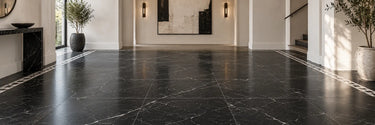
Nero Marquina marble is recognized for its black background and contrasting white veining. Some pieces have restrained linear movement, while others display wider or more irregular veins. This variation helps distinguish genuine stone from a mechanically repeated surface.
Solid Nero Marquina field tiles create a continuous dark surface and are available in square and rectangular sizes. They can be used alone or paired with lighter materials to define borders, room transitions and framed floor features. Review the individual product’s recommended applications before selecting a size or finish.
For a wider view of available stones and colors, compare the complete marble tile collection.
Black Marble Mosaics and Patterns
Marble mosaics introduce smaller pieces, additional grout joints and more detailed patterns. Solid Nero Marquina options include square, brick, herringbone, hexagon, lantern and penny-round arrangements.
Explore herringbone mosaics for directional movement, hexagon mosaics for a geometric surface, brick mosaics for a familiar offset layout and penny-round mosaics for smaller-scale detail.
Decorative basketweave mosaics, pinwheels, octagons, chevrons and other patterns may use black marble as a dot, strip or contrasting component. These designs provide black-marble detail without making the entire surface visually dark.
Black-and-White Checkerboard Tile
Checkerboard tiles combine Nero Marquina with Bianco Carrara, Thassos White, Oriental White, Calacatta Gold and other stones. Black-and-white layouts create the strongest contrast, while black paired with gray, beige, green or burgundy produces a more tonal or colorful interpretation.
Checkerboard tile can define an entryway, bathroom or kitchen floor. It can also be used as a framed feature surrounded by quieter field tile. Confirm the dimensions, finish and recommended applications of both stones in the selected combination before ordering.
Plan Black Marble by Room
On a marble floor, black tile creates visual weight and emphasizes furniture, walls and lighter architectural details. Consider the room’s dimensions, natural light and maintenance expectations before choosing a fully black surface or a mixed checkerboard pattern.
In a bathroom, Nero Marquina can be used on vanity walls, floors, niches and appropriate shower surfaces. Pairing black marble with white fixtures or pale stone creates clear contrast, while warm metal finishes can soften the overall appearance.
For a shower installation, confirm whether the specific tile and finish are approved for the intended wall or floor. Shower floors require particular attention to tile size, grout-joint frequency, drainage, slope and slip characteristics.
In a kitchen, black marble can coordinate with light cabinetry or create a tonal design with darker finishes. Smaller mosaics can be used across a backsplash or as a framed range feature, while field tiles produce a calmer surface with fewer pattern changes.
Black marble also creates a defined surround or feature wall within a fireplace design. Confirm heat-related installation requirements and the suitability of the substrate, setting materials and selected tile.
Finish, Variation and Lighting
Polished black marble reflects more light and generally makes white veining appear stronger. Honed finishes have a smoother, lower-sheen appearance, while tumbled surfaces create softer edges and a more aged character. The same stone can look noticeably different depending on its finish and the room’s lighting.
Dark stone may show dust, water residue, fingerprints or soap film more readily than some lighter materials. Order samples and view them under the project’s natural and artificial lighting before choosing a finish.
Installation, Sealing and Care
Black marble installation requires a suitable substrate, compatible setting materials and careful layout planning. Review the delivered material before installation and blend pieces from multiple boxes to distribute veining and tonal variation naturally.
Many marble installations benefit from sealing, although the correct process depends on the stone, finish, grout, sealer and installation location. Some products may need sealing before grouting and periodic resealing afterward. Sealer does not replace proper waterproofing in wet areas.
For routine care, remove abrasive grit, clean spills promptly and use a pH-neutral cleaner formulated for natural stone. Avoid acidic cleaners and harsh abrasives unless their compatibility with the selected marble has been confirmed.