


Color codes HEX & RGB codes for these stones →
Choose options View details
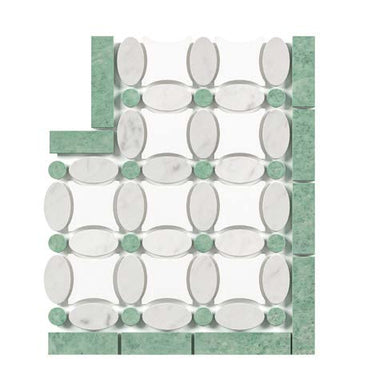
Choose options View details $14.95/ piece / Thassos White Marble Border - Florida Flower with Thassos +Carrara Ovals + Ming-Green DotsIn stock
Choose options View details
Choose options View details
Choose options View details See It in Your Space
ANY 5 SAMPLES: $25 TOTAL. FREE STANDARD SHIPPING.
 $14.95/ piece / Bianco Carrara White Marble Border - Florida Flower Corner with Ming Green DotsIn stock
Choose options View details $14.95/ piece / Bianco Carrara White Marble Border - Florida Flower with Thassos + Carrara Ovals + Ming-Green DotsIn stock
Choose options View details
![Bianco Dolomite Tile - 24x24]()
![Bianco Dolomite Tile - 24x24]()

![Empress-green-marble-tile-backsplash-bathroom-12x12-natural-stone-socaltiles]()
![Empress-green-marble-tile-backsplash-bathroom-12x12-natural-stone]()
![Empress Green Marble Tile - 12x24]()
 $19.95/ sheet (0.8 sq ft) / Thassos White Marble Mosaic - Triple-Weave with Ming-Green DotsIn stock


 $20.95/ sheet (0.96 sq ft) / Thassos White Marble Mosaic - Large Basketweave with Ming-Green DotsIn stock
 $24.95/ sheet (0.7 sq ft) / Thassos White Marble Mosaic - 5in Hexagon Combination Ming-GreenIn stock
Choose options View details


Compare products
Green Marble Tile with Distinctive Stone Character
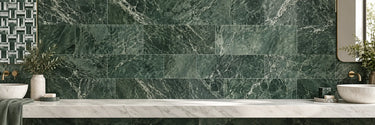
Green marble tile introduces rich natural color, mineral movement and strong visual character to floors, walls and decorative features. Depending on the stone, its color can range from pale celadon and soft Ming green to deeper forest tones with white or gray veining. This collection includes solid green marble field tiles, patterned mosaics and checkerboard combinations for residential and commercial projects.
Green marble can become the main feature of a room or serve as a smaller accent alongside white, black, beige or gray stone. Every piece varies naturally in background tone, vein density and mineral markings, making each completed installation unique.
Ming Green and Empress Green Marble
Ming Green marble typically has a soft green background with white or pale mineral movement. Its lighter color works well in bathrooms, backsplashes and decorative mosaics where the design calls for color without making the room feel overly dark.
Empress Green marble provides a deeper and more expressive green appearance. Its strong contrast and natural veining can create a defined floor, feature wall, vanity backdrop or fireplace surface.
Because shade and movement vary among pieces and production lots, order samples before choosing a material. A sample shows part of the stone’s possible range but cannot represent every tile that may appear in a complete order.
Green Marble Mosaics
Marble mosaics allow green stone to be used in smaller, more detailed patterns. Some designs use Ming Green as a dot, strip or geometric accent against Thassos, Carrara or Calacatta Gold marble. These combinations introduce color while keeping the overall surface light.
Explore basketweave mosaics, hexagon mosaics, chevrons, pinwheels, octagons, Stanza patterns and other decorative arrangements. Pattern scale, grout color and surrounding materials all affect how strongly the green marble appears in the completed installation.
A green-accent mosaic can cover an entire backsplash or feature wall, or it can be used selectively inside a shower niche, behind a range or within a framed floor detail. Confirm the specific mosaic’s recommended applications before selecting it for a wet-area floor.
Green Marble Checkerboard Designs
Checkerboard tiles combine green marble with white, black, beige or burgundy stone. Pairing Ming Green with Thassos, Carrara or Calacatta creates a brighter layout, while Nero Marquina adds deeper contrast. Combinations with Diano Royal or Rojo Alicante introduce warmer undertones.
Checkerboard patterns can define an entryway, bathroom or kitchen floor. They can also form a centered stone rug or framed feature surrounded by quieter field tile. Review both stones in the proposed combination because their colors, veining and finishes will affect one another visually.
Plan Green Marble by Room
In a bathroom, green marble can coordinate with white fixtures, light wood, dark cabinetry and warm or cool metal finishes. Field tile creates a stronger block of color, while a white-and-green mosaic introduces a lighter, more detailed effect.
For a shower installation, green marble may be considered for walls, niches and approved shower-floor applications. Wall suitability does not automatically confirm floor suitability. Tile scale, finish, drainage, slope, grout-joint frequency and slip characteristics must be evaluated for wet floors.
On a kitchen backsplash, green marble adds color behind neutral cabinetry and countertops. A detailed mosaic can create a decorative focal point, while rectangular field tile provides a calmer surface with fewer pattern changes.
A green marble floor can give an entryway, powder room or other selected space a strong architectural identity. Consider the room’s dimensions, lighting and surrounding colors before choosing between solid field tile and a contrasting checkerboard design.
Finish, Color and Natural Variation
Polished marble reflects more light and generally makes green color and veining appear stronger. Honed marble has a smoother, lower-sheen appearance, while tumbled finishes create softer edges and a more aged surface. Finish can affect both appearance and underfoot characteristics.
Review all material before installation and blend pieces from multiple boxes to distribute lighter, darker and more strongly veined tiles naturally. Ask the installer to approve the layout before permanently setting pieces with unusually distinctive movement.
Installation, Sealing and Care
Green marble installation requires a suitable substrate, compatible setting materials and careful planning around cuts, transitions, drains and exposed edges. Some green marbles can react differently to moisture or setting materials than other stones, so a qualified tile installer should confirm the appropriate installation system.
Many marble installations benefit from sealing, although requirements depend on the stone, finish, grout, sealer and installation area. Sealer does not replace waterproofing beneath tile in showers and other wet locations.
For routine maintenance, remove abrasive grit, clean spills promptly and use a pH-neutral cleaner formulated for natural stone. Avoid acidic cleaners and harsh abrasives unless their compatibility with the selected marble has been confirmed.
For additional materials and colors, browse the complete marble tile collection or compare coordinating wall tile.
Explore more: Empress Green Marble Tile · Natural Stone Color Codes · Marble Mosaic Tile