


Calacatta Gold vs Bianco Carrara: Which Italian Marble Is Right for Your Project?
They come from the same mountain range in Tuscany. They're both white. They're both Italian. And they're constantly confused with each other — even by designers who've been specifying natural stone for years.
But Calacatta Gold and Bianco Carrara are genuinely different stones. The difference isn't just price. It's character, veining, rarity, and what each stone is actually built for. This guide breaks down everything you need to know before you decide.
Where Both Marbles Come From
Both stones are quarried in the Apuan Alps of Carrara, Tuscany — the same region that supplied Michelangelo's marble and has defined Italian stone craftsmanship for centuries. The proximity of the quarries is part of why the two are so often confused. But the geological conditions that create each stone — the mineral composition, the vein-forming pressure, the depth of quarry — produce distinctly different results.
Bianco Carrara is by far the more abundant of the two. It has been extracted in large quantities from the Carrara region for millennia and remains one of the most widely available natural marbles in the world. Calacatta Gold is rarer — it comes from specific sections of the quarry and is extracted in significantly smaller quantities. That scarcity is part of what drives its price premium.
The Visual Difference
This is the most important distinction and the one that matters most in a finished installation.
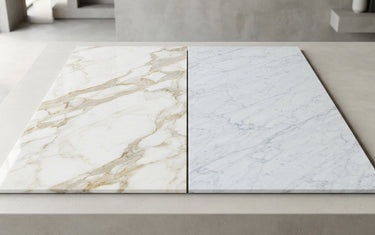
Bianco Carrara has a white to light gray ground with soft, cool blue-gray veining. The veining is relatively consistent — fine, branching lines that move across the face of the tile in a controlled, restrained way. From a distance, Bianco Carrara reads as a clean, quiet white stone. Up close, the delicate gray veining adds depth and natural variation without demanding attention. It recedes. It supports other design elements rather than competing with them. 
Calacatta Gold has a brighter white ground — noticeably whiter than Carrara — with bold, warm gold and honey-toned veining that is dramatically different in both color and scale. Where Carrara's veining is fine and consistent, Calacatta Gold's veining is expressive and variable. Some pieces show fine branching gold lines. Others show a bold diagonal sweep of warm gold that crosses the entire face of the tile. The stone moves. It commands attention. In any installation, Calacatta Gold becomes the focal point. 
The gold tone in the veining is the key differentiator. Bianco Carrara's veining is cool — gray-blue. Calacatta Gold's veining is warm — gold, honey, and sometimes a deeper amber. This single difference changes how each stone reads against cabinetry, hardware, and countertops.
Veining Variation: What to Expect
One of the most important practical differences between the two stones is how much veining varies between individual pieces.
Bianco Carrara is relatively consistent. The gray veining follows similar patterns across most pieces — fine, branching, restrained. You'll see variation between pieces, but the overall character of the stone remains predictable. This consistency makes Bianco Carrara easier to specify, easier to install without careful layout planning, and easier to match between boxes and batches.
Calacatta Gold varies significantly. A tile from one part of a batch may show predominantly fine veining with a subtle gold tone. A tile from the same batch may show a bold, sweeping diagonal of deep gold that spans the full 24-inch face. This is not a quality defect — it is inherent to the stone and is part of what makes Calacatta Gold desirable. But it means installation planning is more involved. Laying out tiles before installation, assessing the distribution of bold and fine-veining pieces, and making deliberate decisions about layout orientation are all essential steps with Calacatta Gold that are optional with Bianco Carrara.
The practical implication: order samples of both stones before committing. With Calacatta Gold in particular, the sample you assess may look notably different from other pieces in your order — assess the range, not just the single sample tile.
Price: How Different Are They?
Meaningfully different. In the SoCal Tiles catalog, Bianco Carrara field tile ranges from around $5.95 to $30.95 per square foot, with an average around $13.79. Calacatta Gold field tile ranges from $9.95 to $48.95, averaging around $21.68.
That's roughly a 50% price premium for Calacatta Gold at the average, widening further at larger formats. A 24×24 Calacatta Gold field tile costs more than twice the equivalent Bianco Carrara in many cases.
For a kitchen backsplash — a relatively small surface area — the premium is manageable and often worth it for the visual impact. For a large floor installation or a full-height shower wall, the cost difference becomes significant. That's where the substitution logic matters: Bianco Carrara can deliver a genuinely beautiful result at a fraction of the cost, if a quieter, more neutral stone suits the project.
What Each Stone Is Best For
Choose Calacatta Gold when:
- The stone is a focal point — a kitchen backsplash, a bathroom feature wall, a fireplace surround — where its bold veining will be seen and appreciated
- The interior palette is warm — brass or gold hardware, warm white or cream cabinetry, wood countertops — and the gold veining will connect the materials
- Budget allows and the stone's visual impact is the priority
- A luxury, high-end, or hotel-quality result is the brief
Choose Bianco Carrara when:
- The stone is a background material — a floor, a shower wall, a full-room installation — where consistency and restraint serve the space better than drama
- The interior palette is cool or neutral — chrome or brushed nickel hardware, gray or white cabinetry — and warm gold veining would conflict
- Budget is a consideration and a beautiful, timeless result can be achieved at a lower price point
- The project is large — a full bathroom, a living room floor — and a consistent, manageable stone is more practical than a highly variable one
How They Compare in Maintenance
Both stones are natural marble — both are porous, both require sealing before installation and periodic resealing, and both are sensitive to acidic cleaners. In this respect they are equivalent.
The one practical difference is visual: on Calacatta Gold, etching from acidic cleaners — the hazier, lighter patch that acid leaves on marble — is more immediately visible because it disrupts the stone's vivid gold veining and bright white ground. On Bianco Carrara, the same etching is less visually jarring against the softer gray veining and quieter white ground.
For both stones: use pH-neutral cleaners exclusively. Avoid vinegar, citrus-based products, and any cleaner not specified as stone-safe. Seal before installation and reseal as recommended by your installer.
Formats Available at SoCal Tiles
Both stones are available across an extensive range of formats.
Calacatta Gold field tile is available in 3×6, 2×8, 4×12, 6×12, 12×12, 12×24, 18×18, 18×36, and 24×24. All sizes are available in polished and honed finishes, with micro-beveled and long-side bullnosed edge options on select sizes. Mosaics span 60+ SKUs across herringbone, brick, basketweave, hexagon, chevron, pinwheel, stanza, and more. Six checkerboard combinations pair Calacatta Gold with Nero Marquina, Bardiglio Nuvolato, Crema Marfil, Diano Royal, Botticino, and Ming Green.
Bianco Carrara field tile is available in the same size range — 3×6 through 24×24 in polished and honed. Mosaics span 58+ SKUs including herringbone, brick, basketweave, hexagon, pinwheel, chevron, penny round, Greek key, bias, flower, and lantern (arabesque) patterns — a broader mosaic pattern range than Calacatta Gold. Checkerboard combinations pair Bianco Carrara with Nero Marquina, Bardiglio Imperiale, Bardiglio Nuvolato, Oriental White, Botticino, Crema Marfil, Diano Royal, Ming Green, and Rojo Alicante.
Both stones also offer trim pieces — pencil liner, bullnose liner, baseboard, quarter-round, and chair rail — for complete wall installations.
Side-by-Side Summary
| Calacatta Gold | Bianco Carrara | |
|---|---|---|
| Origin | Carrara, Tuscany, Italy | Carrara, Tuscany, Italy |
| Ground color | Bright white | White to light gray |
| Veining color | Warm gold and honey | Cool blue-gray |
| Veining intensity | Bold, dramatic, expressive | Subtle, restrained, consistent |
| Veining variation | High — significant piece-to-piece variation | Moderate — more consistent between pieces |
| Price tier | Premium | Mid-range |
| Best application | Focal point — backsplash, feature wall, fireplace | Background material — floor, shower wall, large installations |
| Palette | Warm — brass, gold hardware, warm cabinetry | Neutral to cool — chrome, gray or white cabinetry |
| Maintenance | pH-neutral cleaners, regular sealing | pH-neutral cleaners, regular sealing |
| Durability | Equivalent — both Italian calcite marble | Equivalent — both Italian calcite marble |
| Available formats | Field tile 3×6–24×24, 60+ mosaics, 6 checkerboard combos | Field tile 3×6–24×24, 58+ mosaics, 9 checkerboard combos |
The Bottom Line
Calacatta Gold and Bianco Carrara are not interchangeable. They are genuinely different stones with different characters, different applications, and different price points. Choosing between them isn't about which is "better" — it's about which one serves your specific project.
If you want a stone that commands the room, connects with warm hardware and cabinetry, and creates an installation that people notice and remember — Calacatta Gold is the choice.
If you want a stone that works in almost any interior, provides a consistently beautiful natural surface, and delivers a timeless result at a lower price — Bianco Carrara is the choice.
Both are available in extensive formats at SoCal Tiles. Order samples of each — one for $7.95, or any 5 for $25 with free standard shipping on sample-only orders — and see them in your own space, in your own lighting, against your own cabinets and hardware. That comparison, in your actual space, is the only one that matters.
Browse Calacatta Gold Marble Tile and Bianco Carrara White Marble Tile at SoCal Tiles. Order samples before you commit.
